

Germany Microbolometer Market Expands with Automation; Teledyne FLIR Leads
Microbolometer
Thermal imaging adoption in automotive and Industry 4.0 drives growth
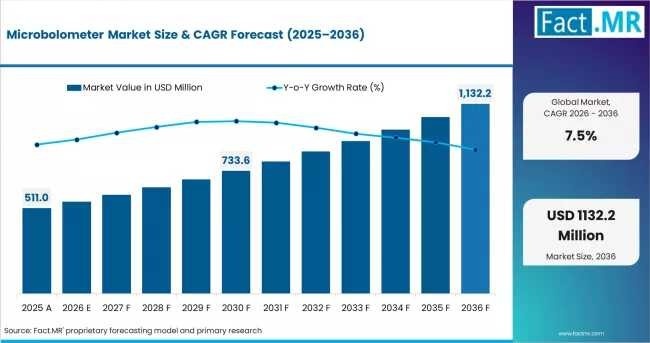
ROCKVILLE, MD, UNITED STATES, April 16, 2026 /EINPresswire.com/ -- According to the latest analysis by Fact MR, Germany is solidifying its position as a global nerve center for uncooled infrared technology. As the nation accelerates its "Industrie 4.0" mandates and autonomous driving protocols, the demand for microbolometers—the critical sensors behind thermal imaging—is shifting from specialized defense use to mainstream industrial and automotive applications.The Germany microbolometer market is valued at USD 511.0 million in 2026 and is projected to reach USD 1,058.6 million by 2036. Growing at a steady CAGR of 7.9%, this expansion highlights an incremental opportunity of USD 547.6 million. The transformation is primarily fueled by the replacement of expensive, bulky cooled infrared detectors with compact, high-performance uncooled microbolometers that offer superior reliability for predictive maintenance and perimeter security.
Get detailed market forecasts, competitive benchmarking, and pricing trends:
https://www.factmr.com/connectus/sample?flag=S&rep_id=14735
Quick Stats Section
Market Size (2026E): USD 511.0 Million
Forecast Value (2036F): USD 1,058.6 Million
Projected CAGR:9%
Leading Material Segment: Vanadium Oxide (VOx) – 63% Share
Leading Wavelength: Long Wave Infrared (LWIR) – 46% Share
Key Growth Region: Germany (Europe’s Precision Hub)
Key Players: Teledyne FLIR LLC, Lynred (ULIS), BAE Systems plc, Leonardo DRS Inc., Excelitas Technologies Corp., Xenics NV.
Executive Insight for Decision Makers
The German market is witnessing a fundamental strategic shift: the democratization of thermal vision. For OEMs and industrial investors, the priority is no longer just "seeing in the dark" but "analyzing heat in real-time."
Manufacturers must invest in Vanadium Oxide (VOx) thin-film fabrication to meet the stringent sensitivity requirements of the German automotive and aerospace sectors. Risks of not adapting to these uncooled architectures include high operational costs and exclusion from the rapidly growing AI-enabled machine vision ecosystem.
Market Dynamics
Key Growth Drivers:
Automotive ADAS Integration: Rising demand for thermal sensing in pedestrian detection and night vision for autonomous vehicles.
Industrie 4.0 Machine Vision: Deployment of infrared modules for non-contact temperature monitoring in automated factories.
Security & Surveillance: Increased spending on perimeter protection for critical German infrastructure.
Key Restraints:
Export Control Complexity: Strict Wassenaar Arrangement dual-use controls on high-resolution sensors.
Cost Sensitivity: High fabrication costs of high-pixel-density detector arrays.
Emerging Trends:
AI-Enhanced Analytics: Integration of thermal data with deep learning for anomaly detection in energy grids.
Miniaturization: Development of "plug-and-play" thermal modules for mobile and IoT devices.
Segment Analysis
Vanadium Oxide (VOx) leads the material segment with a 63% share in 2026, prized for its stable resistance and high thermal sensitivity. Strategically, the Long Wave Infrared (LWIR) wavelength segment dominates with 46%, as it allows for precise imaging at ambient temperatures—a critical requirement for German industrial thermography and building energy audits.
Supply Chain Analysis: The Precision Ecosystem
The German supply chain is a highly specialized "Who Supplies Whom" network:
Raw Material & Semiconductor Suppliers: Provide VOx and Amorphous Silicon ($a-Si$) materials and specialized wafers.
Sensor Manufacturers: Global giants like Lynred and Teledyne FLIR produce the microbolometer focal plane arrays.
Module Integrators: Specialized German engineering firms (e.g., Xenics NV) package these sensors into ruggedized camera cores.
End-Users: Automotive OEMs (BMW, Mercedes-Benz), Defense contractors (Rheinmetall), and Industrial giants (Siemens) utilize these modules for night vision, missile guidance, and factory monitoring.
Pricing Trends
Premium vs. Commodity: High-resolution sensors (640x480 and above) command premium pricing due to low yields in semiconductor fabrication. Low-resolution sensors are increasingly becoming commoditized for smartphone and HVAC applications.
Influencing Factors: Pricing is heavily dictated by pixel pitch (smaller pitch equals higher cost) and vacuum packaging integrity.
Margin Insights: High margins remain in the defense and medical thermography sectors where accuracy is prioritized over cost.
Regional Analysis: Germany’s Role
Within Europe, Germany is the leading demand hub with a 7.9% CAGR. While the UK (8.1%) shows slightly higher growth due to recent defense spending spikes, Germany's growth is more broadly distributed across Automotive (Bavaria) and Industrial Automation (Baden-Württemberg). German demand is characterized by a preference for high-precision, uncooled systems that meet "Industrie 4.0" standards.
Competitive Landscape
The market is moderately consolidated, with Teledyne FLIR and Lynred holding significant IP over VOx fabrication.
Competitive Strategy: Companies are shifting toward "Software-Defined Thermal Imaging," where the hardware is sold alongside AI-driven analytics packages.
Recent Moves:Xenics NV recently expanded its development capabilities in Germany (April 2023) to better serve the local machine vision market.
Strategic Takeaways
For Manufacturers: Focus on 12μm pixel pitch architectures to balance resolution with compact device sizes.
For Investors: High-growth potential lies in the "Smart City" infrastructure and EV battery monitoring segments.
For Marketers: Emphasize the "Safety and Reliability" of uncooled tech over legacy cooled systems to win over risk-averse German industrial buyers.
Future Outlook
By 2036, the German market will transition toward Multi-Spectral Sensing, combining thermal and visible light in a single microbolometer-driven chip. As sustainability becomes a core KPI for German firms, microbolometers will play a vital role in identifying energy leaks in hydrogen infrastructure and EV thermal management systems.
Conclusion
Germany's microbolometer market is at a crossroads of innovation and industrial necessity. For decision-makers, the move toward uncooled, high-sensitivity VOx sensors is the only path to achieving the precision required by next-generation autonomous and automated systems.
Why This Market Matters
Microbolometers are the "eyes" of the energy transition. By enabling machines to see heat, we reduce industrial waste, prevent electrical fires, and make autonomous transportation a reality. In the context of Germany’s energy goals, this technology is a non-negotiable asset.
Full Report: Unlock 360° insights for strategic decision making and investment planning-
https://www.factmr.com/checkout/14735
To View Related Report:
Site 5 Semiconductor Intermediates Market https://www.factmr.com/report/site-5-semiconductor-intermediates-market
Photochromic Temperature Labels Market https://www.factmr.com/report/photochromic-temperature-labels-market
Regenerative Braking Optimization Software Market https://www.factmr.com/report/regenerative-braking-optimization-software-market
Fiber Network Latency and Sync Test Equipment Market https://www.factmr.com/report/fiber-network-latency-and-sync-test-equipment-market
S. N. Jha
Fact.MR
+1 628-251-1583
email us here
Legal Disclaimer:
EIN Presswire provides this news content "as is" without warranty of any kind. We do not accept any responsibility or liability for the accuracy, content, images, videos, licenses, completeness, legality, or reliability of the information contained in this article. If you have any complaints or copyright issues related to this article, kindly contact the author above.
