

US Food & Beverage Air Filtration Market grows on compliance, led by Parker-Hannifin, Donaldson & Camfil adoption.
US Food & Beverage Air Filtration Market
Strict food safety rules, HVAC upgrades, and rising contamination control needs drive demand for advanced air filtration systems in U.S. facilities.
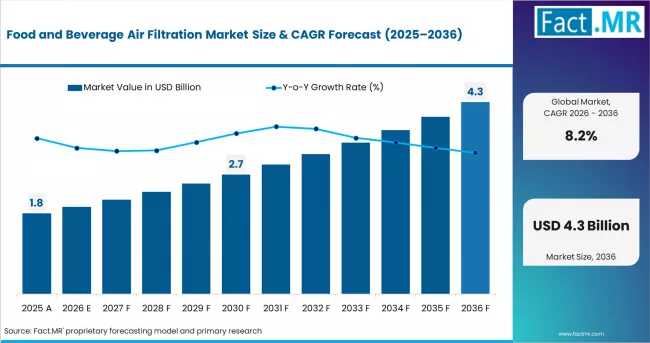
ROCKVILLE, MD, UNITED STATES, April 16, 2026 /EINPresswire.com/ -- According to Fact.MR’s latest analysis, the United States food and beverage air filtration market is valued in line with global trends, contributing a significant share to the USD 1.8 billion global market in 2026, and is expected to grow steadily through 2036. The broader market is projected to reach USD 4.0 billion by 2036, expanding at a CAGR of 8.2%, while the U.S. market itself is forecast to grow at approximately 8.0% CAGR over the same period.Get detailed market forecasts, competitive benchmarking, and pricing trends: https://www.factmr.com/connectus/sample?flag=S&rep_id=14729
The U.S. market is undergoing a transformation driven by Food Safety Modernization Act (FSMA) compliance, modernization of food processing facilities, and increasing adoption of high-efficiency filtration technologies. Demand is further supported by recurring replacement cycles across large-scale manufacturing plants.
Quick Stats
Market Size (2026 – Global Reference): USD 1.8 Billion
Forecast Value (2036 – Global): USD 4.0 Billion
U.S. CAGR (2026–2036): ~8.0%
Incremental Opportunity (Global): USD 2.2 Billion
Leading Segment: HEPA & ULPA Filters (~28% share)
Leading End Use: Dairy Processing (~14% share)
Leading Country Focus: United States (regulated market leader)
Key Players: Parker-Hannifin Corporation, Donaldson Company, Camfil AB, Pall Corporation, Freudenberg Filtration Technologies
Executive Insight for Decision Makers
The U.S. market is shifting toward compliance-first, performance-driven filtration systems integrated with advanced HVAC infrastructure.
Strategic priorities:
Upgrade legacy systems to high-efficiency particulate filtration
Integrate filtration with smart monitoring and airflow control systems
Expand aftermarket services and replacement cycles
Risk of inaction:
Non-compliance with FSMA regulations
Increased contamination risks and product recalls
Loss of competitive positioning in a highly regulated environment
Market Dynamics
Key Growth Drivers
Strong enforcement of food safety regulations (FSMA, HACCP)
Continuous upgrades in food and beverage processing facilities
High adoption of HVAC-integrated filtration systems
Significant replacement demand due to mandatory filter cycles
Key Restraints
High installation cost of advanced filtration systems
Energy consumption concerns in high-efficiency filters
Operational cost pressures for small processors
Emerging Trends
Adoption of IoT-enabled filtration monitoring systems
Increasing demand for energy-efficient filtration technologies
Expansion of cleanroom environments in food production
Growth in modular and scalable filtration systems
Segment Analysis
Leading Segment:
HEPA and ULPA filters dominate with ~28% share due to strict air purity requirements.
Fastest-Growing Segment:
Activated carbon filters, driven by odor and chemical control needs in processing plants.
Breakdown
By Filter Type: HEPA/ULPA, pleated filters, activated carbon, moisture separators
By Application: Beverage, dairy, packaged food, ready-to-eat processing
By End Use: Dairy, meat processing, beverage manufacturing
Strategic Importance:
Dairy and beverage segments require controlled microbial environments, making high-efficiency filtration essential for compliance and product quality.
Supply Chain Analysis (Critical Insight)
Value Chain Structure
Raw Material Suppliers:
Synthetic fiber media producers, activated carbon suppliers
Manufacturers:
Develop filtration systems and HVAC-integrated solutions
Distributors & Integrators:
HVAC contractors, industrial equipment suppliers
End Users:
Large food processing companies
Beverage manufacturers
Dairy production facilities
Who Supplies Whom
Raw material providers supply filter media to manufacturers
Manufacturers integrate systems into HVAC and clean air infrastructure
Distributors install and maintain systems for processing plants
End users drive recurring demand through replacement cycles and compliance upgrades
Pricing Trends
Commodity Systems: Basic filtration units with lower cost
Premium Systems: HEPA/ULPA and cleanroom-grade solutions with higher pricing
Key Pricing Drivers
Regulatory compliance requirements
Raw material and filter media costs
Energy efficiency and lifecycle performance
Customization and system integration
Margin Insight:
Premium filtration systems deliver higher margins due to compliance value and performance reliability, while service contracts ensure stable revenue streams.
Regional Analysis (United States Focus)
The United States represents one of the most mature and regulation-driven markets globally.
Growth Drivers in the U.S.
Strong regulatory framework (FSMA, FDA guidelines)
Large-scale food and beverage manufacturing base
Continuous facility modernization and automation
Market Characteristics
High replacement demand
Strong adoption of advanced filtration technologies
Emphasis on energy efficiency and sustainability
Competitive Landscape
Market Structure: Moderately concentrated
Key Players
Parker-Hannifin Corporation
Donaldson Company, Inc.
Camfil AB
Pall Corporation
Freudenberg Filtration Technologies
American Air Filter Company
Porvair plc
Competitive Strategies
Innovation in high-efficiency filtration media
Expansion of service and maintenance offerings
Strategic partnerships with food processing companies
Focus on energy-efficient and compliant solutions
Strategic Takeaways
For Manufacturers
Invest in advanced filtration technologies aligned with FSMA standards
Strengthen aftermarket service capabilities
For Investors
Focus on companies with strong presence in regulated markets
Prioritize firms with recurring revenue models
For Distributors
Build expertise in HVAC-integrated filtration systems
Emphasize compliance-driven value propositions
Future Outlook
The U.S. market will continue to evolve toward smart, energy-efficient, and fully compliant air filtration ecosystems. Digital monitoring, sustainability, and automation will shape the next phase of growth.
Conclusion
The United States food and beverage air filtration market stands at the forefront of regulatory-driven innovation and technological advancement. Companies that align with compliance standards and invest in high-efficiency systems will secure long-term growth opportunities.
Why This Market Matters
In the United States, air filtration is not optional—it is a critical component of food safety, operational efficiency, and regulatory compliance, making it a cornerstone of modern food and beverage manufacturing.
Full Report: Unlock 360° insights for strategic decision making and investment planning- https://www.factmr.com/checkout/14729
To View Related Report:
Intraocular Filtration Devices Market https://www.factmr.com/report/1158/intraocular-filtration-devices-market
Membrane Filtration Systems Market https://www.factmr.com/report/4235/membrane-filtration-systems-market
Virus Filtration Market https://www.factmr.com/report/virus-filtration-market
Laboratory Filtration Market https://www.factmr.com/report/laboratory-filtration-market
S. N. Jha
Fact.MR
+1 628-251-1583
email us here
Legal Disclaimer:
EIN Presswire provides this news content "as is" without warranty of any kind. We do not accept any responsibility or liability for the accuracy, content, images, videos, licenses, completeness, legality, or reliability of the information contained in this article. If you have any complaints or copyright issues related to this article, kindly contact the author above.
