

Global Urban Mining Market Led by Boliden Group, Umicore Across Europe Dominance and Circular Economy Growth
Urban Mining Market
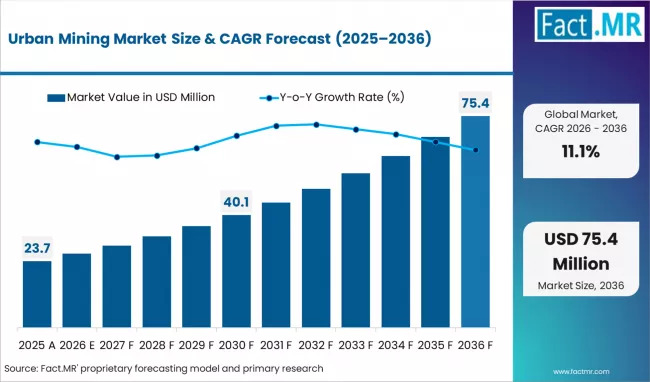
Global Urban Mining Market Poised to Hit USD 75.44 Million by 2036; Precious Metal Recovery from E-Waste Drives 11.10% CAGR
ROCKVILLE, MD, UNITED STATES, April 8, 2026 /EINPresswire.com/ -- The global Urban Mining market is undergoing a radical structural shift, transitioning from a niche recycling activity into a strategic resource-security powerhouse. According to the latest market analysis, the industry valued at USD 23.70 million in 2025 is projected to reach USD 26.33 million in 2026, ultimately scaling to USD 75.44 million by 2036.For Details Deep insights, Please Request A sample report for Free: https://www.factmr.com/connectus/sample?flag=S&rep_id=12016
This trajectory represents a significant 11.10% CAGR, creating an incremental opportunity of USD 49.11 million. As virgin ore grades decline and geopolitical tensions threaten primary supply chains, urban mining has emerged as the definitive solution for high-purity secondary metal extraction.
Executive Summary: The Circular Economy Shift
The urban mining sector is now a regulation-driven category where extraction efficiency and precious metal purity define market leadership. With global e-waste exceeding 60 million metric tonnes annually, the "urban ore" found in discarded electronics offers gold, palladium, and copper concentrations significantly higher than traditional mines.
"In my analysis, certified purity output is becoming the primary competitive variable," says Shambhu Nath Jha, Principal Consultant at Fact.MR. "Refinery procurement managers will not accept secondary materials below 99.95% purity without heavy price penalties. Operations investing in multi-stage hydrometallurgical refining to meet LBMA standards will capture the premium contracts."
Key Market Segmentation & Performance (2026)
Material Outlook: Precious Metals Dominance
Market Share:0%
Driver: The high commodity value of gold, silver, and platinum group metals (PGMs) justifies the capital-intensive nature of advanced refining.
Efficiency Benchmark: Leading operators are now achieving recovery rates above 95% using specialized hydrometallurgical circuits.
Waste Type: The E-Waste Powerhouse
Market Share:3%
Trend: Shortened product lifecycles in consumer electronics (smartphones, tablets) have created a consistent, high-value feedstock.
Secondary Segment:Construction & Demolition (33.5%) remains a vital source for structural steel, copper wiring, and aluminum fixtures.
Regional Analysis: China and Germany Lead Growth
Growth distribution is increasingly concentrated in regions with robust "Extended Producer Responsibility" (EPR) frameworks.
Country
Projected CAGR (2026-2036)
Primary Driver
China
15.0%
Massive manufacturing base and mandated recycling targets.
Germany
14.5%
EU circular economy mandates and Industry 4.0 integration.
India
14.2%
Formalization of e-waste sectors in major tech hubs like Bangalore.
USA
13.9%
Critical minerals security via the CHIPS and Science Act.
Brazil
13.5%
Government incentives for secondary mineral recovery.
Supply Chain & Competitive Landscape
The market is characterized by moderate fragmentation, with 30-40 key players. The competitive moat is built on technical certification and metallurgical expertise rather than just volume.
Key Industry Players: Boliden Group, Umicore, Johnson Matthey, Excir, Materion Corporation, and ExxonMobil Corporation.
Supply Dynamics: Processors are increasingly forming "closed-loop" partnerships directly with OEMs (Original Equipment Manufacturers) to secure feedstock in exchange for high-purity recycled content.
Strategic Implications for Decision-Makers
For Investors: Prioritize assets with documented 95%+ recovery rates for gold and palladium. These thresholds determine eligibility for premium off-take contracts with global refineries.
For Municipal Authorities: Tenders should shift from "volume-based collection" to "recovery-rate requirements" to ensure materials enter formal, high-efficiency processing circuits.
For Manufacturers: Securing secondary supply chains is no longer just a sustainability goal; it is a risk mitigation strategy against volatile primary commodity markets.
Future Outlook
The integration of AI-powered robotic sorting and blockchain-based traceability is expected to be the next frontier. As "Green Steel" and "Recycled Gold" certifications become industry standards, the urban mining sector will serve as the backbone of a resilient, decarbonized industrial supply chain.
For instant access to this report, click “Buy Now” or connect with our analyst for customization:
https://www.factmr.com/checkout/12016
To View Our Related Report:
Urban Turf Insecticides Market: https://www.factmr.com/report/urban-turf-insecticides-market
Lithium Mining Market: https://www.factmr.com/report/lithium-mining-market
Space Mining Market: https://www.factmr.com/report/space-mining-market
Chromium Mining Market: https://www.factmr.com/report/chromium-mining-market
S. N. Jha
Fact.MR
+1 628-251-1583
email us here
Legal Disclaimer:
EIN Presswire provides this news content "as is" without warranty of any kind. We do not accept any responsibility or liability for the accuracy, content, images, videos, licenses, completeness, legality, or reliability of the information contained in this article. If you have any complaints or copyright issues related to this article, kindly contact the author above.
