

Not all treatment wetlands behave alike in the carbon balance
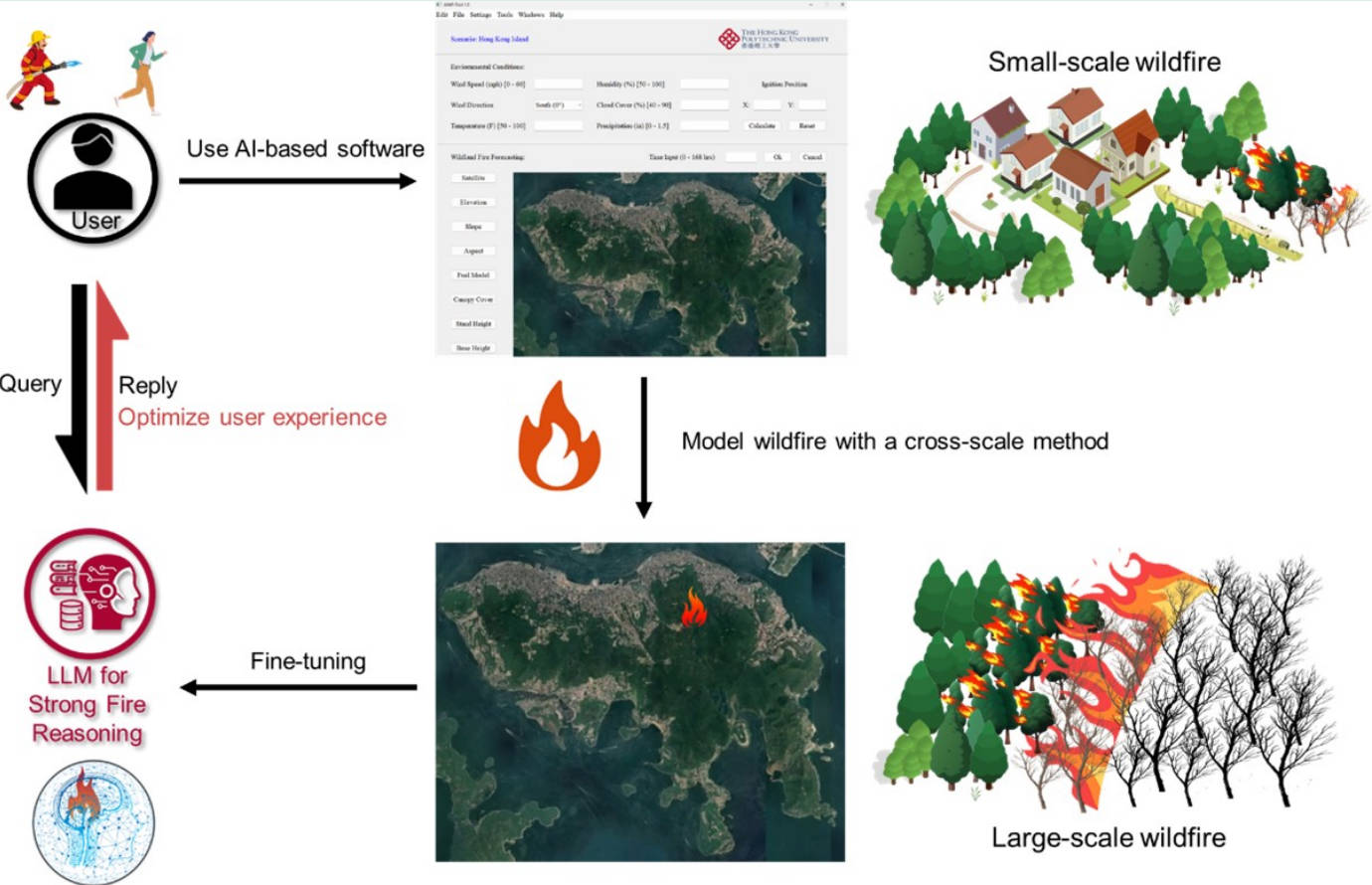
LLM-assisted cross-scale wildfire simulation framework.
GA, UNITED STATES, April 1, 2026 /EINPresswire.com/ -- Wildfires do not grow in a straight line. They begin as tiny, hard-to-detect ignition points and can rapidly expand into fast-moving fronts that threaten lives, infrastructure, and fragile landscapes. This study presents a cross-scale deep-learning framework that tackles both phases in one workflow, combining fine-resolution forecasting for early fires with coarser but scalable prediction for larger events. Built on 240 simulated wildfire cases and 8640 samples, the model forecasts wildfire spread across sizes from 25 m² to 20 km², reaches overall accuracy above 75%, and supports lead times from 2 to 72 hours.
Forecasting wildfire spread in real time remains one of the most difficult tasks in emergency management. Traditional statistical, semi-empirical, and physics-based models can provide valuable insights, but they often demand heavy computation, specialist knowledge, or both. In dense wildland-urban interface settings, those limits matter: responders need fast, localized forecasts, not results that arrive too late to guide action. In places such as Hong Kong, where urban development sits close to vegetated hillsides, even relatively small fires can become dangerous. Based on these challenges, in-depth research is needed on wildfire forecasting systems that are both high-resolution and operationally fast.
Researchers from The Hong Kong Polytechnic University reported (DOI: 10.1007/s11783-026-2165-1) online on March 10, 2026, in Engineering Environment that they had developed a real-time wildfire forecasting framework called Fast Cross-Scale Deep Learning, using Hong Kong Island as a demonstration area. The study combines wildfire simulation, deep learning, and software deployment to predict both the wildfire front and burning region with practical speed for emergency response.
The team began with a practical problem: early fires are small, sparse, and easy for AI to miss, while large fires generate image sizes that are expensive to process. To solve this, they designed a two-stage strategy. For early-stage fires lasting less than 12 hours or burning under 1000 m², they kept the original 5-meter resolution and divided images into thousands of overlapping blocks so the model could “see” scarce burned pixels more clearly. For larger fires, they resized the imagery and divided it into nine overlapping blocks, reducing computation while preserving spread patterns. The dataset itself came from FARSITE wildfire simulations and covered 240 cases across different wind speeds, wind directions, and ignition points on Hong Kong Island. Using U-Net-based models, the framework achieved an F1-score of 0.65 for early-stage fires and 0.75 for large-scale fires, while large-fire prediction accuracy reached about 85% with errors below 15%. Compared with benchmark simulation, the AI system delivered predictions in seconds to tens of seconds rather than tens of minutes.
According to the authors, the real value of the framework lies in connecting AI research with field decision-making. Their system is not just a model but part of a broader emergency-support workflow, designed to generate rapid forecasts, reduce computational burden, and make wildfire modeling more accessible to responders. At the same time, the study is careful about its current limits: early-stage prediction remains harder than forecasting larger, more developed fires, showing that the first moments after ignition are still the toughest for AI to capture reliably.
The study points toward a future in which wildfire forecasting becomes faster, more scalable, and more usable in real emergencies. The researchers also developed the Intelligent Wildfire Forecast Tool, or IWFTool, to translate the model into a practical platform for 72-hour wildfire prediction and response support. That matters especially in high-risk wildland-urban interfaces, where minutes can shape evacuation, suppression, and resource deployment decisions. Although demonstrated in Hong Kong, the cross-scale design could be adapted to other fire-prone regions seeking fast, lower-cost forecasting tools that bridge the gap between advanced modeling and frontline action.
DOI
10.1007/s11783-026-2165-1
Origianl Source URL
https://doi.org/10.1007/s11783-026-2165-1
Funding information
This work was funded by the National Natural Science Foundation of China (No. 52322610), Hong Kong Research Grants Council Theme-based Research Scheme (T22-505/19-N), and the PolyU Research Institute for Sustainable Urban Development Joint Research Fund (P0058005).
Lucy Wang
BioDesign Research
email us here
Legal Disclaimer:
EIN Presswire provides this news content "as is" without warranty of any kind. We do not accept any responsibility or liability for the accuracy, content, images, videos, licenses, completeness, legality, or reliability of the information contained in this article. If you have any complaints or copyright issues related to this article, kindly contact the author above.
