

Storage Class Memory Market 2026 High-Speed Data Storage Technologies Driving Adoption

Storage Class Memory Global Market Report 2026 – Market Size, Trends, And Forecast 2026-2035

Storage Class Memory Global Market Report 2026 – Market Size, Trends, And Forecast 2026-2035
Storage Class Memory Global Market Report 2026 – Market Size, Trends, And Forecast 2026-2035
The Business Research Company’s Storage Class Memory Global Market Report 2026 – Market Size, Trends, And Forecast 2026-2035
LONDON, GREATER LONDON, UNITED KINGDOM, March 17, 2026 /EINPresswire.com/ -- Storage class memory market to surpass $22 billion in 2030. Within the broader Information Technology industry, which is expected to be $13,807 billion by 2030, the Storage Class Memory market is estimated to account for nearly 0.2% of the total market value.
Which Will Be The Biggest Region In The Storage Class Memory Market in 2030
Asia-Pacific will be the largest region in the storage class memory market in 2030, valued at $9 billion. The market is expected to grow from $2 billion in 2025 at a compound annual growth rate (CAGR) of 36%. The exponential growth can be attributed to increasing adoption of high-performance computing, growing demand from data centers, expanding consumer electronics markets, rising investment in memory fabrication, increasing integration in enterprise IT, and government support for semiconductor development across countries such as China, Japan, South Korea, and India.
Which Will Be The Largest Country In The Global Storage Class Memory Market In 2030?
The USA will be the largest country in the storage class memory market in 2030, valued at $5 billion. The market is expected to grow from $2 billion in 2025 at a compound annual growth rate (CAGR) of 26%. The exponential growth can be attributed to increasing adoption of high-performance computing and enterprise servers, rising demand for data-intensive applications and cloud computing, growing investment in AI and machine learning infrastructures, expanding deployment of memory solutions in consumer electronics, increasing integration in data center operations, and continuous government and private sector support for semiconductor research and advanced memory technologies across the country.
Request A Free Sample Of The Storage Class Memory Market Report
https://www.thebusinessresearchcompany.com/sample_request?id=28840&type=smp&utm_source=EINPresswire&utm_medium=Paid&utm_campaign=Mar_PR
What Will Be The Largest Segment In The Storage Class Memory Market In 2030?
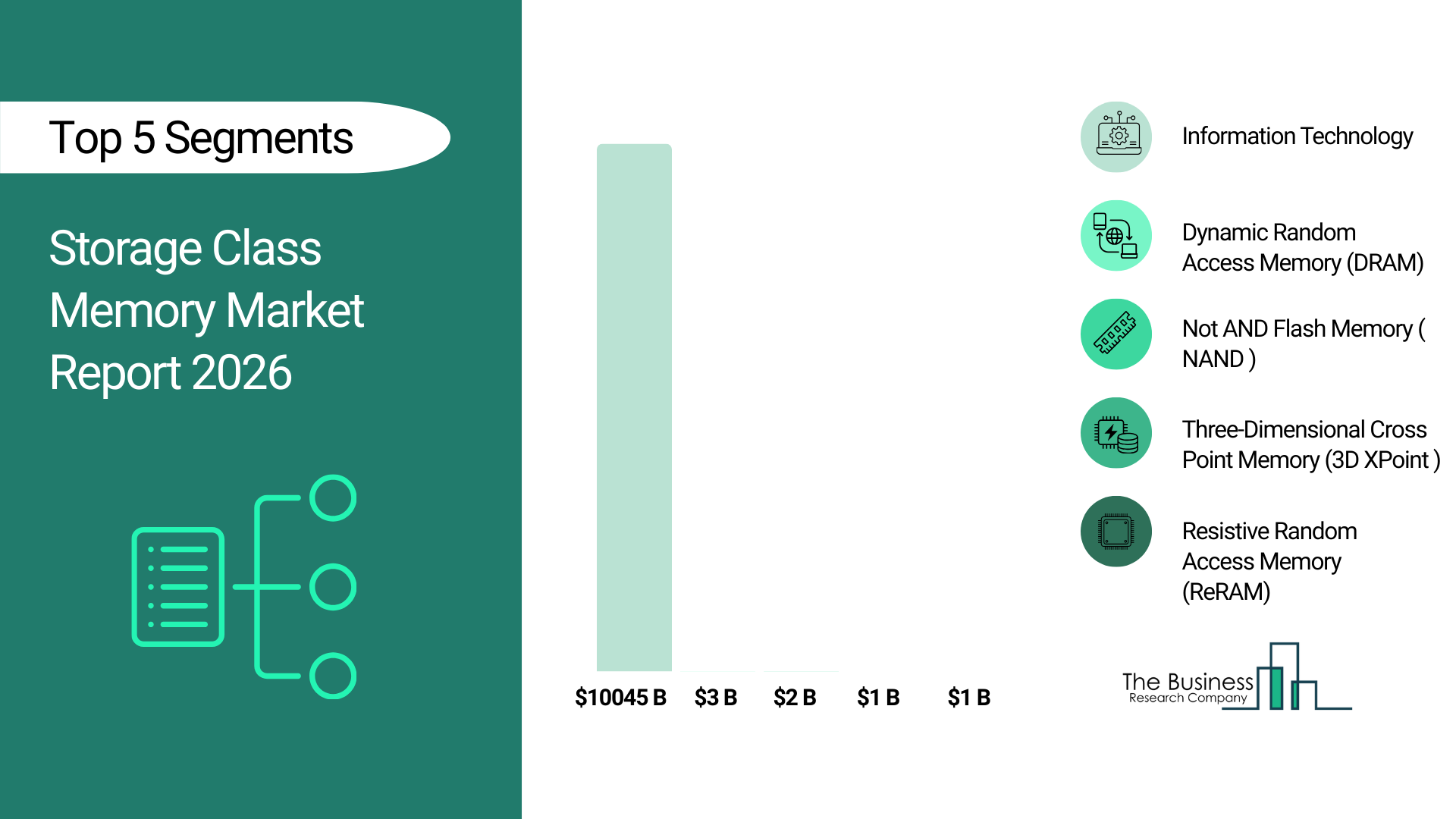
The storage class memory market is segmented by type into dynamic random access memory (DRAM), NOT and (NAND) flash memory, resistive random access memory (ReRAM), three-dimensional cross point memory (3D XPoint), and other types. The dynamic random access memory (DRAM) market will be the largest segment of the storage class memory market segmented by type, accounting for 34% or $8 billion of the total in 2030. The dynamic random access memory (DRAM) market will be supported by the increasing demand for high-speed data processing, growing adoption in enterprise servers and cloud computing, rising deployment in AI and machine learning applications, expanding use in high-performance computing systems, increasing integration in consumer electronics and mobile devices, and continuous investment in semiconductor R&D and memory optimization technologies.The storage class memory market is segmented by technology type into phase change memory (PCM), resistive random-access memory (ReRAM), magnetoresistive random-access memory (MRAM), non-volatile dual inline memory modules (NVDIMM), 3D not and flash memory (NAND Flash Memory), and other emerging SCM technologies.The storage class memory market is segmented by storage capacity into low-capacity storage class memory, medium-capacity storage class memory, high-capacity storage class memory.The storage class memory market is segmented by deployment model into public cloud, private cloud, hybrid cloud.The storage class memory market is segmented by end-user into information technology (IT) and telecommunication, consumer electronics, automotive, healthcare, aerospace and defense, other end users.
The storage class memory market is segmented by technology type into phase change memory (PCM), resistive random-access memory (ReRAM), magnetoresistive random-access memory (MRAM), non-volatile dual inline memory modules (NVDIMM), 3D not and flash memory (NAND Flash Memory), and other emerging SCM technologies.
The storage class memory market is segmented by storage capacity into low-capacity storage class memory, medium-capacity storage class memory, high-capacity storage class memory.
The storage class memory market is segmented by deployment model into public cloud, private cloud, hybrid cloud.
The storage class memory market is segmented by end-user into information technology (IT) and telecommunication, consumer electronics, automotive, healthcare, aerospace and defense, other end users.
What Is The Expected CAGR For The Storage Class Memory Market Leading Up To 2030?
The expected CAGR for the storage class memory market leading up to 2030 is 30%.
What Will Be The Growth Driving Factors In The Global Storage Class Memory Market In The Forecast Period?
The rapid growth of the global storage class memory market leading up to 2030 will be driven by the following key factors that are expected to reshape enterprise storage architectures, high-performance computing, energy-efficient data centers, and innovation across global memory and semiconductor ecosystems.
Rising Demand For High-Performance Storage - The rising demand for high-performance storage is expected to become a key growth driver for the storage class memory market by 2030. The rising demand for high-performance storage acts as a major driver for storage-class memory (SCM) as enterprises seek faster data processing and reduced latency. SCM bridges the gap between traditional DRAM and NAND flash, delivering superior speed and endurance for data-intensive workloads. With the increasing use of artificial intelligence, big data analytics, and cloud computing, organizations require storage solutions that can handle massive data volumes efficiently. SCM’s ability to provide rapid access and persistent memory makes it ideal for high-performance computing environments. Consequently, its adoption is accelerating across data centers and enterprise storage systems. As a result, the rising demand for high-performance storage is anticipated to contributing to 2.0% annual growth in the market.
Government Initiatives To Promote Energy-Efficient Technologies - The government initiatives to promote energy-efficient technologies is expected to emerge as a major factor driving the expansion of the storage class memory market by 2030. Government initiatives to promote energy-efficient technologies act as a major driver for storage class memory (SCM) adoption. SCM offers faster data access with lower power consumption compared to traditional storage solutions, aligning with global energy efficiency goals. Subsidies, tax incentives, and funding for green IT infrastructure encourage organizations to invest in energy-saving memory technologies. Such policies accelerate research, development, and large-scale deployment of SCM in data centers and enterprise systems. Consequently, government support enhances SCM market growth by fostering innovation and sustainable computing practices. Consequently, the government initiatives to promote energy-efficient technologies is projected to contribute to around 1.7% annual growth in the market.
Increasing Focus On Energy Efficiency - The increasing focus on energy efficiency is expected to act as a key growth catalyst for the storage class memory market by 2030. The increasing focus on energy efficiency acts as a major driver for storage class memory (SCM) adoption because it offers lower power consumption compared to traditional DRAM and NAND technologies. SCM reduces energy usage by enabling faster data access and minimizing the need for frequent data transfers between memory and storage. Its non-volatile nature allows systems to retain data without continuous power, further enhancing energy savings. As data centers and enterprises aim to meet sustainability goals, SCM helps cut operational costs and carbon emissions. This growing demand for greener, high-performance computing solutions is propelling the SCM market forward. Therefore, the increasing focus on energy efficiency is projected to contribute to approximately 1.5% annual growth in the market.
Access The Detailed Storage Class Memory Market Report Here
https://www.thebusinessresearchcompany.com/report/storage-class-memory-global-market-report?utm_source=EINPresswire&utm_medium=Paid&utm_campaign=Mar_PR
What Are The Key Growth Opportunities In The Storage Class Memory Market In 2030?
The most significant growth opportunities are anticipated in the dynamic random access memory (DRAM) market, the NOT and (NAND) flash memory market, the resistive random access memory (ReRAM) market, the three-dimensional cross point memory (3D XPoint) market, and other types market. Collectively, these segments are projected to contribute over $16 billion in market value by 2030, driven by increasing demand for high-speed data processing, growing adoption in cloud computing and enterprise servers, rising deployment in AI and machine learning applications, expanding use in consumer electronics and mobile devices, continuous investment in semiconductor R&D, and advancements in memory optimization and integration technologies. This surge reflects the accelerating focus on enhancing system performance, improving energy efficiency, and supporting next-generation computing and data storage innovations, fuelling transformative growth within the global memory and semiconductor industry.
The dynamic random access memory (DRAM) market is projected to grow by $5 billion, NOT and (NAND) flash memory market by $4 billion, the resistive random access memory (ReRAM) market by $2 billion, the three-dimensional cross point memory (3D XPoint) market by $3 billion, and the other types market by $2 billion over the next five years from 2025 to 2030.
Learn More About The Business Research Company
The Business Research Company (www.thebusinessresearchcompany.com) is a leading market intelligence firm renowned for its expertise in company, market, and consumer research. We have published over 17,500 reports across 27 industries and 60+ geographies. Our research is powered by 1,500,000 datasets, extensive secondary research, and exclusive insights from interviews with industry leaders.
We provide continuous and custom research services, offering a range of specialized packages tailored to your needs, including Market Entry Research Package, Competitor Tracking Package, Supplier & Distributor Package and much more.
Disclaimer: Please note that the findings, conclusions and recommendations that TBRC Business Research Pvt Ltd delivers are based on information gathered in good faith from both primary and secondary sources, whose accuracy we are not always in a position to guarantee. As such TBRC Business Research Pvt Ltd can accept no liability whatever for actions taken based on any information that may subsequently prove to be incorrect. Analysis and findings included in TBRC reports and presentations are our estimates, opinions and are not intended as statements of fact or investment guidance.
Contact Us:
The Business Research Company
Americas +1 310-496-7795
Europe +44 7882 955267
Asia & Others +44 7882 955267 & +91 8897263534
Email: info@tbrc.info
Follow Us On:
LinkedIn: https://in.linkedin.com/company/the-business-research-company"
Oliver Guirdham
The Business Research Company
+44 7882 955267
info@tbrc.info
Legal Disclaimer:
EIN Presswire provides this news content "as is" without warranty of any kind. We do not accept any responsibility or liability for the accuracy, content, images, videos, licenses, completeness, legality, or reliability of the information contained in this article. If you have any complaints or copyright issues related to this article, kindly contact the author above.
